



Some executives are promoted because they are dependable.
Then they stop growing for the same reason.
They become the person who delivers.
The person who absorbs pressure.
The person who protects the system.
The person who takes a directive from the top and turns it into execution without creating noise.
For a while, this works.
In many organizations, especially large commercial ones, being the “good soldier” is rewarded. You become known as mature, loyal, disciplined, and easy to trust.
You do not create friction.
You do not challenge too much.
You understand hierarchy.
You know how to make things happen.
But there is a point where this becomes a trap.
Because the higher you go, the job changes.
The job changes before the title does
At one level, leadership is about executing the plan.
At another level, leadership is about improving the plan.
Many executives miss that shift.
They keep proving they can deliver, while the business is waiting to see whether they can shape.
I learned this in environments where execution was everything: sales targets, channel plans, launches, trade investments, customer negotiations, field execution, route-to-shopper realities.
In that world, reliability matters.
But reliability alone is not enough.
I saw leaders who understood the market better than the people setting the direction. They knew when a plan was too optimistic. They knew when a target ignored customer reality. They knew when a launch timeline looked good on slides but would collapse in the field.
They knew when a “strategic priority” was actually just a senior person’s preference with a PowerPoint behind it.
And still, many stayed quiet.
Not because they were weak.
Because they had been trained to believe that loyalty meant alignment.
Blind loyalty may keep you safe in the short term, but it can make you small in the long term.
Loyalty is not silence
This is one of the most expensive misunderstandings in corporate life.
Loyalty is not nodding in the meeting and then explaining privately why the plan will fail.
Loyalty is not protecting a weak decision because it came from someone senior.
Loyalty is not keeping the dashboard green until reality makes the problem impossible to hide.
Real loyalty is having enough commitment to the business to challenge what does not make sense before the damage becomes visible.
The problem is that many organizations prefer the appearance of alignment over the discomfort of truth.
The meeting looks clean.
Everyone agrees.
The decision moves forward.
The dashboard stays green.
Then reality arrives.
The market does not respond.
The customer pushes back.
The field team struggles.
The cost increases.
The timeline slips.
The result misses.
And then comes the sentence everyone hates hearing:
“We saw this coming.”
If people saw it coming, why was it not challenged when it mattered?
Usually because the room rewarded compliance more than judgment.
That is dangerous for the business.
But it is also dangerous for the executive.
The good soldier ceiling
There is a ceiling for leaders who only execute.
They may manage large teams.
They may own big numbers.
They may be respected operators.
But when the most important conversations happen — the conversations about direction, choices, investment, risk, and future growth — they may not be the first people invited into the room.
Not because they lack experience.
Because they have not shown enough strategic tension.
They have proven they can carry the plan.
They have not proven they can improve the plan.
That difference matters.
At a certain level, your value is no longer measured only by how well you deliver what was agreed.
It is measured by whether you can improve what gets agreed in the first place.
The provocative ally
The best executives I have worked with were not rebels.
They were not loud for the sake of being noticed.
They did not challenge every decision to look smart.
They did not confuse disagreement with leadership.
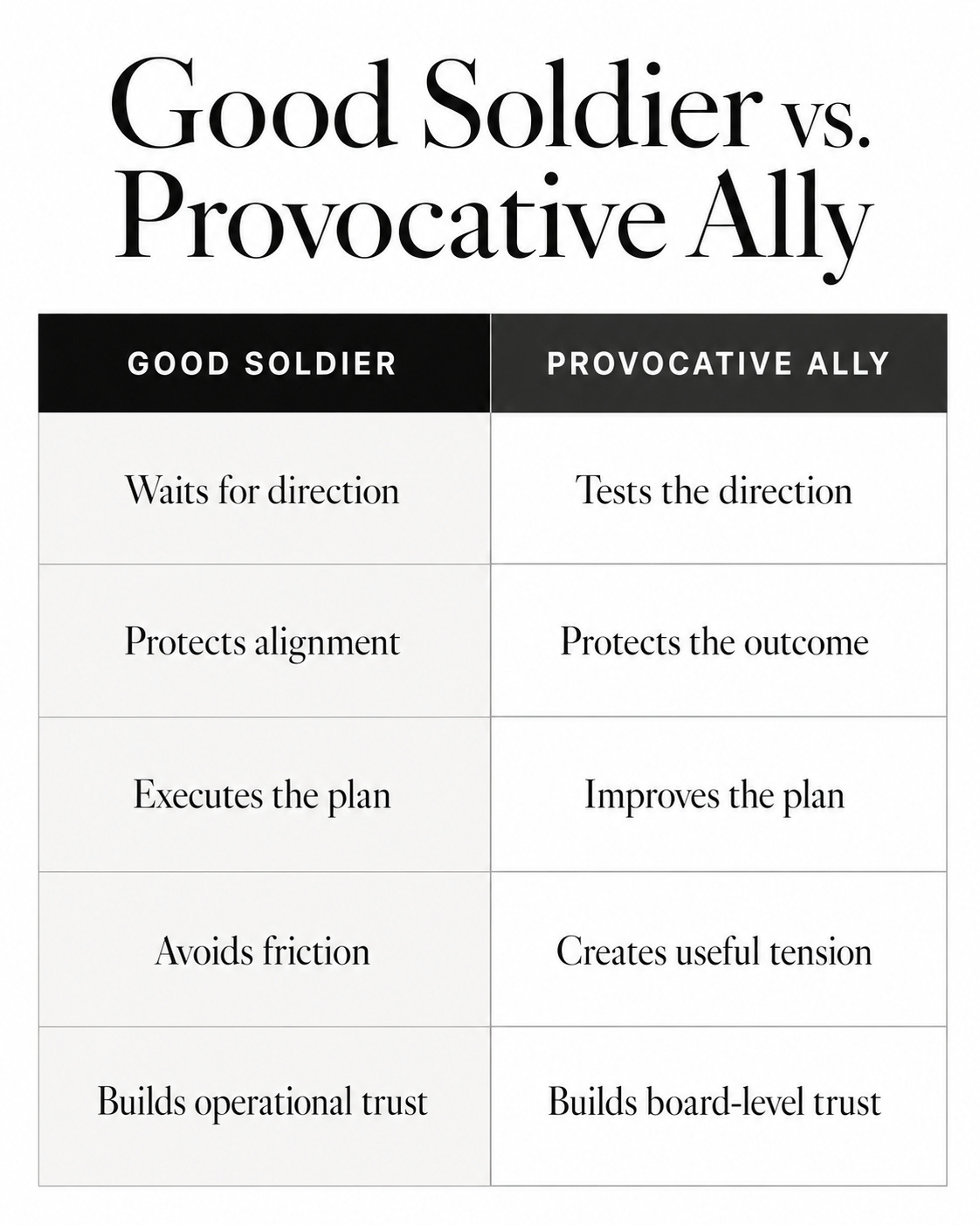
They were provocative allies.
They understood the business deeply enough to know when something was wrong.
And they cared about the enterprise enough to say it.
A provocative ally does not attack the person.
He tests the assumption.
He does not say, “This will not work,” and leave the room satisfied with his courage.
He says:
“This assumption may not hold.”
“Here is what we are seeing in the market.”
“Here is the risk if we continue.”
“Here is a better path.”
That is not resistance.
That is contribution.
There is a big difference between being difficult and being useful.
Difficult people create tension around themselves.
Useful leaders create tension around the quality of the decision.
One is ego.
The other is leadership.
A simple test
Before challenging a directive, ask yourself five questions:
1. Is this issue material enough to challenge?
Not every disagreement deserves escalation.
2. Am I protecting the business or protecting my preference?
There is a big difference.
3. Can I support my challenge with evidence?
Market reality, customer feedback, field intelligence, financial logic, or operational constraints.
4. Do I have a better alternative?
Criticism without a path forward is rarely executive contribution.
5. Am I willing to own part of the outcome?
If the business accepts your view, you cannot stay safely on the sidelines.
This is where many executives need to build a different muscle.
Not the muscle of execution. They already have that.
The muscle of strategic challenge.
Knowing when to push back.
Knowing how to disagree without making it personal.
Knowing how to bring evidence instead of emotion.
Knowing how to offer an alternative, not only a criticism.
Knowing how to stay accountable after the challenge.
Operational trust says: “He can deliver.”
Board-level trust says: “He can see what others are missing.”
The question that changes the room
The good soldier asks:
“What do you want me to do?”
The executive asks:
“What must be true for this to succeed?”
That one question can change the quality of a decision.
It forces the room to slow down.
It exposes assumptions.
It separates ambition from operating reality.
It turns passive alignment into active thinking.
And sometimes, it prevents the business from making an expensive mistake.
The most dangerous career trap is not failure.
It is becoming too useful in the wrong role.
Useful enough to execute.
Reliable enough to depend on.
Loyal enough to stay quiet.
But not trusted enough to shape.
At executive level, your value is not only in your ability to deliver the plan.
It is in your courage to improve the plan before execution exposes what everyone was too polite to say.
A question to think about:
Where in your career did you stay silent because you thought loyalty meant alignment — and what did that silence cost?